
St PetersCE Primary School
Geography
'The study of geography is about more than just memorising places on a map. It's about understanding the complexity of our world...' — Barack Obama
Curriculum Intent
At St Peter’s, we believe that Geography is fundamental to developing children’s understanding of the world around them and their place within it. We are committed to providing a high-quality Geography curriculum which inspires children’s curiosity about the world, encourages them to ask questions and enables them to develop a deep understanding of the diverse people, places and environments that make up our planet.
Geography lessons at St Peter’s are skilfully designed and sequenced to develop children’s essential locational knowledge, place knowledge and understanding of human and physical geography, alongside the geographical fieldwork skills that they need to investigate the world around them. Children will be given opportunities to explore maps, take part in fieldwork, use geographical vocabulary, observe patterns and identify connections between people, places and environments. We place a strong emphasis on questioning, enquiry, making comparisons and explaining geographical processes, ensuring that these skills become increasingly embedded and transferable throughout their time at St Peter’s.
We aim to enrich children’s geographical learning by providing a range of meaningful and memorable experiences. From exciting VR workshops that immerse children in the landscapes of volcanoes and the Alps, bringing coastal learning to life through a trip to Weymouth or experiencing the unique conditions of the rainforest at the Living Rainforest, we seek to make geography purposeful and engaging. Through these experiences, children are encouraged to develop their curiosity about the world and deepen their geographical knowledge and understanding.
We want to develop our learners into ethical geographers who can understand and discuss some of the much-debated geographical topics of our modern world. Each geography topic has an ethics question for children to explore throughout the unit. During their time at St Peter’s children will…
- Explore the impact of human activity on physical landscapes, including mountains, coasts and rainforests, considering how our actions can shape and change the natural world.
- Understand issues of sustainability, exploring the opportunities and challenges presented by different energy sources, human settlements and the ways in which we use the Earth’s resources.
- Explore the relationship between people and the environment, considering how physical environments create both opportunities and challenges for human settlement, livelihoods and economic development.
Curriculum Design
Each unit of our Geography curriculum is built around one of three key geographical ideas:
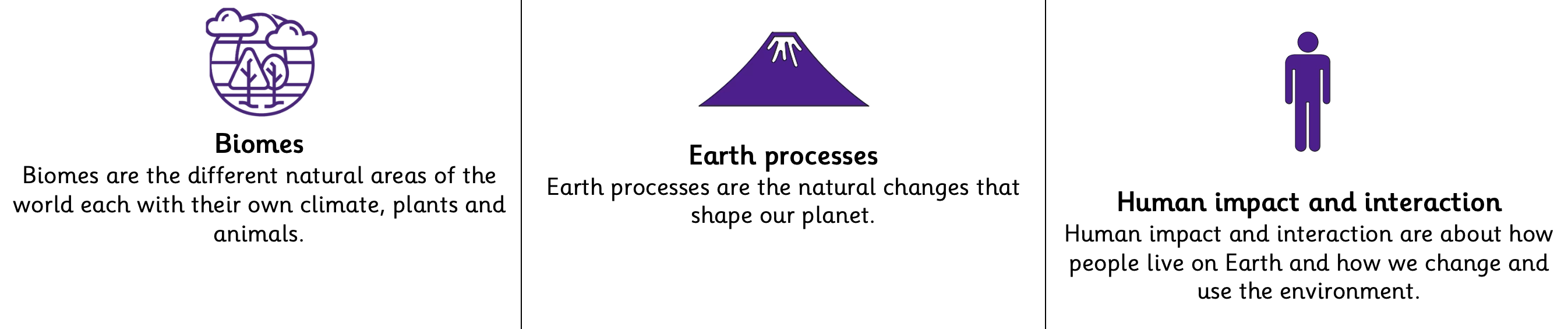
Across these units, children develop their geographical knowledge and understanding through purposeful and engaging learning, making connections between people, places and environments and exploring how the world around them is shaped and changed. Our Big Ideas enable children to begin to see links between topics in their geographical learning journey

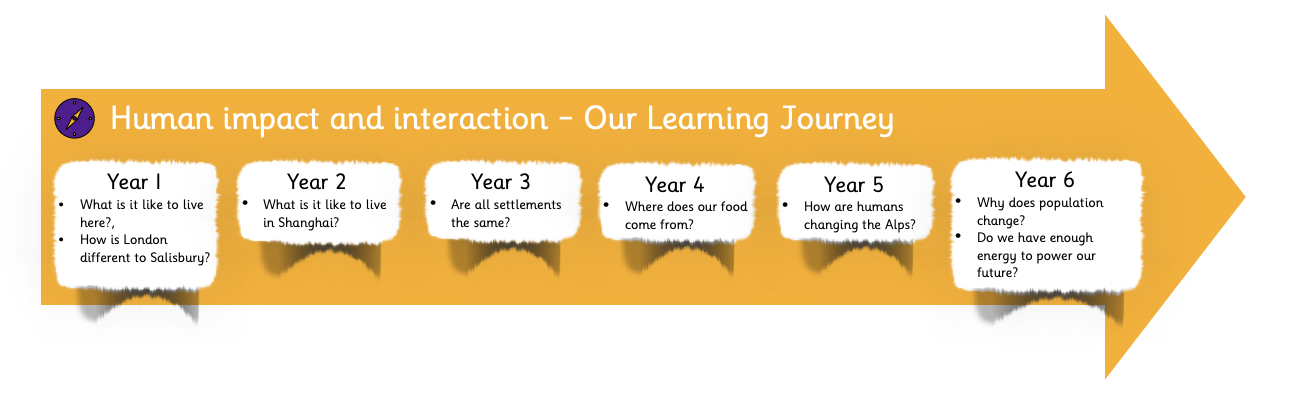
Throughout each topic, children’s knowledge and understanding is underpinned by four key geographical concepts: location, place, human and physical geography, and fieldwork. Each concept has carefully sequenced key learning, ensuring that children build a broad and balanced understanding of Geography as they progress through the school. Through opportunities to investigate, compare, question, interpret and apply their knowledge, children develop the geographical skills they need to understand and explore the world around them.
