St PetersCE Primary School
Writing
We want all of our children to become successful and confident writers. From the beginnings of EYFS through to the end of Year 6 the children develop their writing skills through immersion in high-quality key texts and visual units. For each unit of work (key text) the children are expected to produce at least two pieces of high quality writing. Below is an overview of the key texts that children will enjoy over the coming academic year.
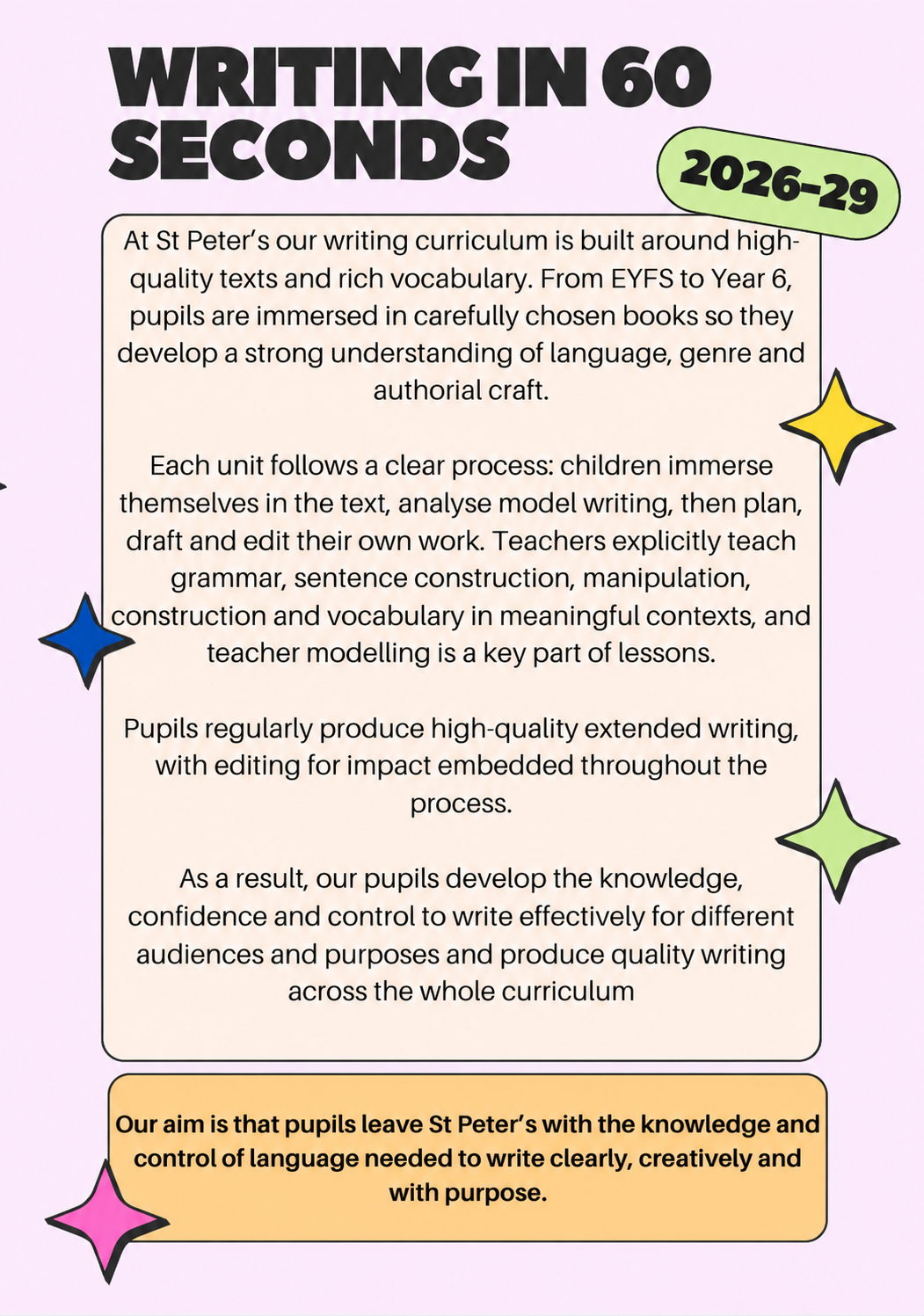
At St. Peter’s, we explicitly teach children how to develop, organise and communicate their ideas through writing. High quality texts, ambitious vocabulary and purposeful talk underpin our approach.
Our writing process includes four core elements: immersion, deconstruction, the plan and success criteria. These sit within a carefully sequenced journey that includes explicit teaching, teacher modelling, oral rehearsal, drafting and editing. We expect children to apply their learning and write to a high standard across the curriculum.
Phase One: Building knowledge and exploring the text
Context and background knowledge
Teachers read each key text carefully and identify the knowledge children need to understand its content, themes and setting. We explicitly teach this background knowledge so that all children can access the text, regardless of their previous experiences.
Immersion and vocabulary exploration
Children explore the key text through reading, pictures, visual media, drama and discussion. Teachers explicitly teach ambitious vocabulary, developing children’s understanding of words and how to use them effectively. Connections with previously studied texts help pupils deepen their understanding of themes, language and authors’ choices.
Oral rehearsal
Talk is a fundamental part of the writing journey across the school. Children discuss ideas, rehearse sentences and explain their thinking before and during writing. This helps them organise their thoughts and consider how their language will sound to a reader.
Phase Two: Understanding how writing works
Explicit teaching of grammar and sentence construction
Teachers explicitly teach the grammar, punctuation and sentence structures children need for their writing, in line with curriculum expectations. New learning builds on previous teaching, with a clear focus on how particular choices communicate meaning and affect the reader.
Deconstruction
Children analyse a high quality teacher written model of the text type they will produce. Creating this model enables teachers to work through the demands of the task and anticipate where pupils may need support. Through guided discussion, children explore its structure, language and techniques, considering why the writer has made particular choices and their effect on the reader.
The plan
In KS2, children organise their ideas using agreed planning formats. Teachers explicitly model how to select relevant ideas, make useful notes and sequence content. Children explain their plans to a learning partner, using discussion to clarify and develop their thinking before drafting.
Phase Three: Writing, reviewing and improving
Success criteria
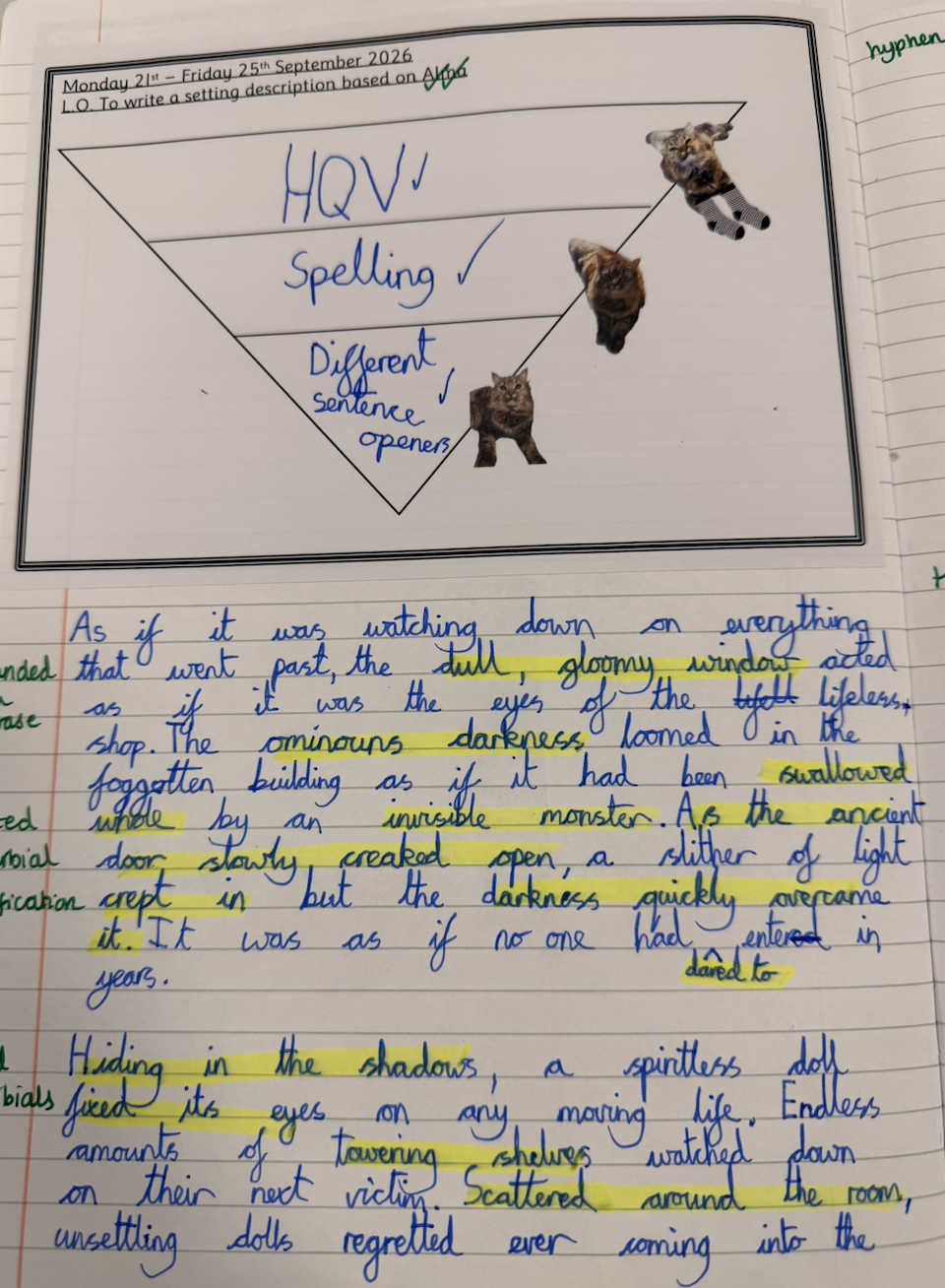
Children use a success triangle to identify areas of focus and take increasing ownership of their writing. Teachers guide these choices so that expectations remain ambitious and appropriate to each child’s knowledge and next steps.
Writing and teacher modelling
Extended writing develops over several lessons. Teachers regularly model how writers compose sentences, make choices and review their work, explaining their thinking aloud. Children draw on classroom discussion and collective wisdom to offer constructive suggestions and improve their own and others’ writing.
Editing and proofreading
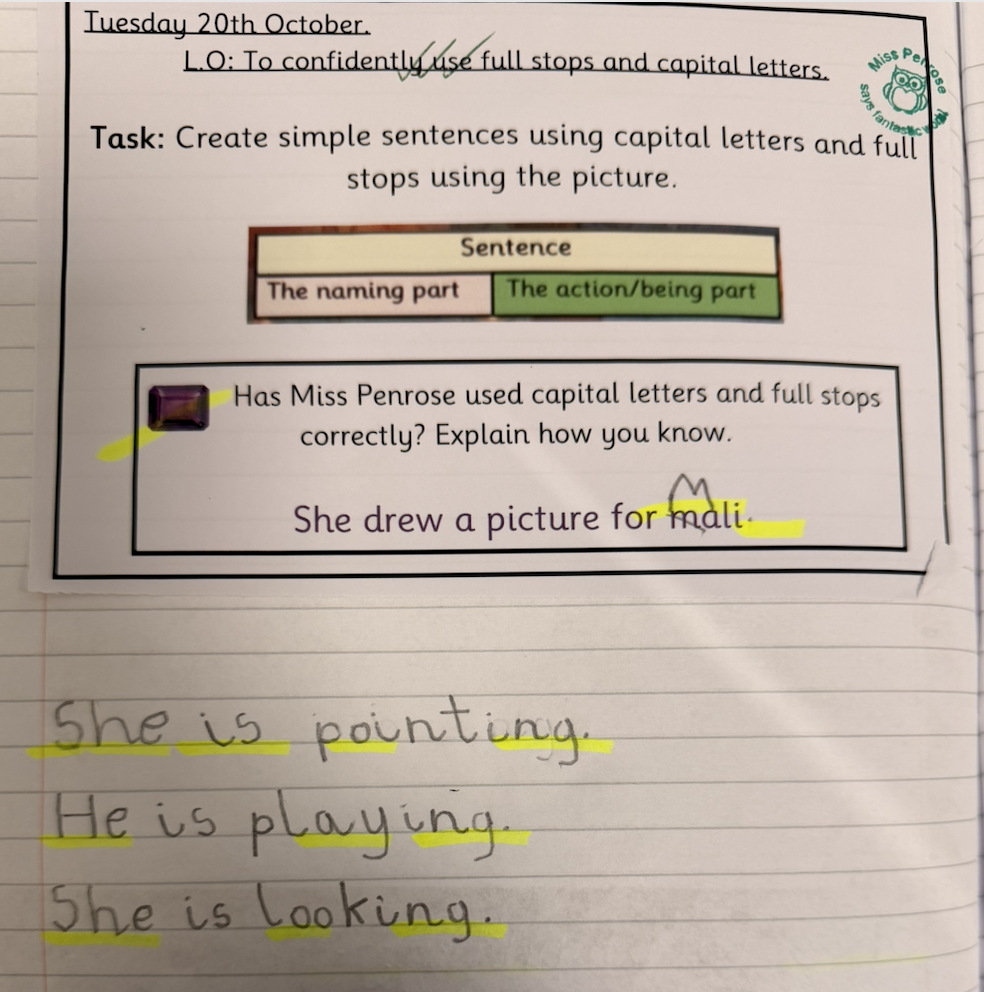
Children learn that reviewing and improving writing happens throughout the process. In KS1, they reread their work to check that it makes sense and, with support, improve sentences and correct spelling and punctuation using what they have been taught.
In KS2, children increasingly evaluate organisation, vocabulary, sentence construction and impact on the reader. They also proofread for spelling, punctuation and grammatical accuracy.
Securing the foundations
Explicit teaching of spelling and handwriting supports children throughout their writing journey. Our aim is for children to become increasingly fluent, accurate and independent writers who can express their ideas effectively for different audiences and purposes.